
The creatures that roam this island are a mix of many breeds. When the
Polynesians arrived on the islands of Hawai’i, they brought with them
the red jungle fowl, a breed of bird native to Southeast Asia that is
the ancestor of those found in the current day. After Captain Cook’s
landing, Europeans brought along domesticated chickens that were used
as a food source and the Filipinos who came to the islands to work on
sugar plantations brought their own chickens, bred for fighting. Even
later, American chickens bred specifically for their meat and eggs
were introduced because none of the species already on the island had
much food value. Within a decade, two hurricanes befell the Hawaiian
Islands: Hurricane Iwa in 1982 and Hurricane Iniki in 1992. In the
destruction, domesticated chickens from all over were released into
the wild, interbreeding and blending into the bird that dominates
Kauai today.
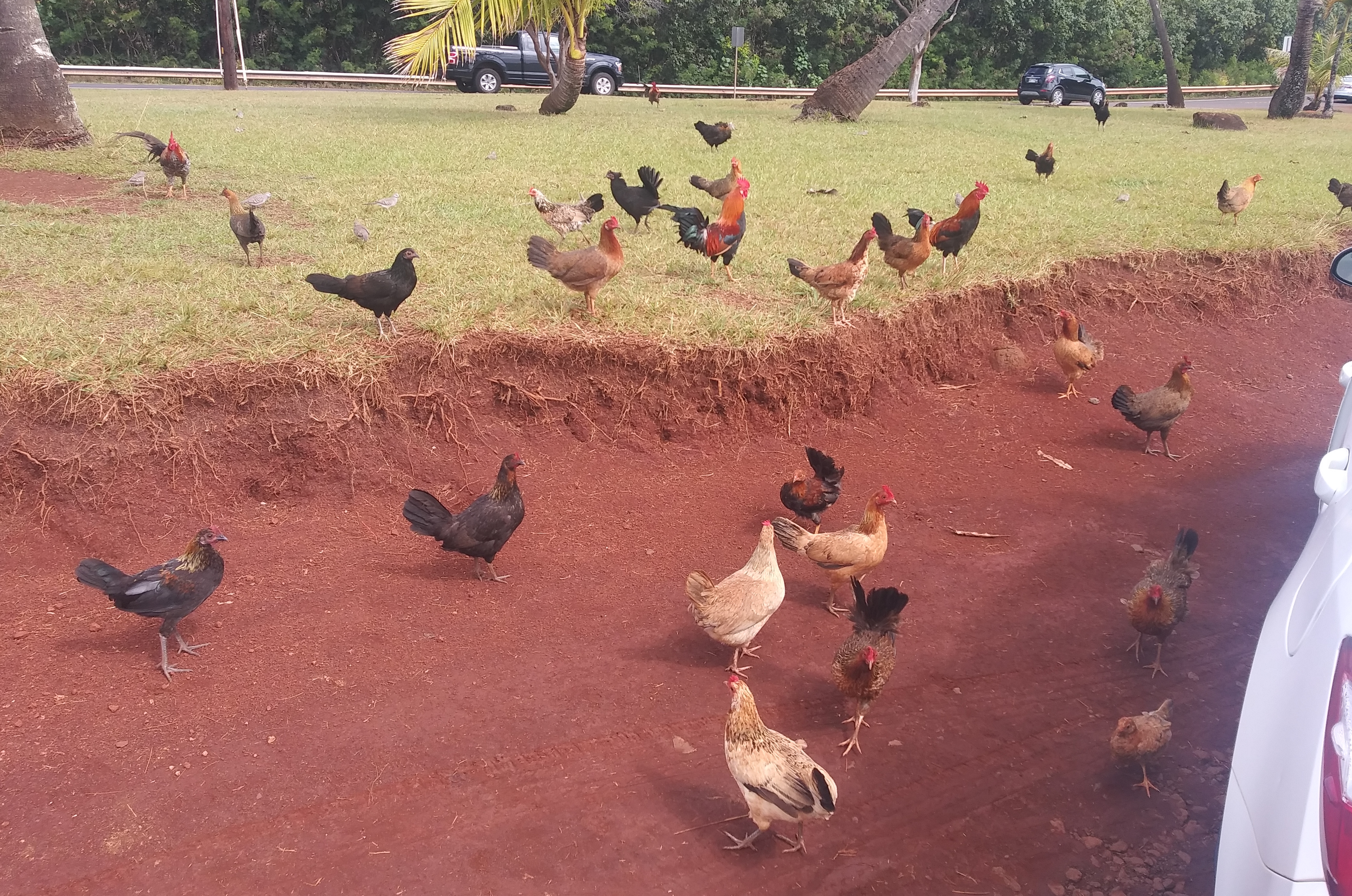 On the other islands, natural predators, namely the mongoose, keep the
chicken populations under control. Kauai, however, lacks this furry
carnivore and the number of chickens flourishes. The other obvious
predator would be the human inhabitants of the island. Indeed you
would think, restaurants like Chicken in a Barrel have this seemingly
endless supply of livestock quite literally walking in the door, why
wouldn’t they use it? First, the chickens aren’t quite the strain
you’d find caged up on a poultry farm, they don’t lay many eggs and
those they do lay are small, and physically, they’re more adapted to
running around, and evading human threats than being plumped up for a
meal. Second, locals say that to eat one of the wild chickens, you’d
have to boil it in a pot for several hours with two rocks and in the
end, the rocks will turn out softer than the chicken.
On the other islands, natural predators, namely the mongoose, keep the
chicken populations under control. Kauai, however, lacks this furry
carnivore and the number of chickens flourishes. The other obvious
predator would be the human inhabitants of the island. Indeed you
would think, restaurants like Chicken in a Barrel have this seemingly
endless supply of livestock quite literally walking in the door, why
wouldn’t they use it? First, the chickens aren’t quite the strain
you’d find caged up on a poultry farm, they don’t lay many eggs and
those they do lay are small, and physically, they’re more adapted to
running around, and evading human threats than being plumped up for a
meal. Second, locals say that to eat one of the wild chickens, you’d
have to boil it in a pot for several hours with two rocks and in the
end, the rocks will turn out softer than the chicken.
Though the chickens may seem like the island’s pets as they star in many murals painted on building sides and can be found in all the little craft shops that line the main road through Kapa’a, there are many locals who think differently. The creatures have been known to dig up gardens and bring disease to farmers’ trees as they scratch at the ground, foraging for food. Farmers even sometimes trap and kill them like an infestation of rats or gather them up in cages to transport to other parts of the island. Other inhabitants, however, are grateful for them because the chickens feast on centipedes, including a species that is poisonous to humans. Of course, the tourists love seeing the birds. It’s not many places where you can be woken up at 4:00 am to rooster calls, share lunch with a family of chickens, and watch a hen teaching her chicks to cross the road on their own all in one day. For better or for worse, these birds are a staple on Kaua’i and they certainly create a unique spectacle.
On the other islands, natural predators, namely the mongoose, keep the
chicken populations under control. Kauai, however, lacks this furry
carnivore and the number of chickens flourishes. The other obvious
predator would be the human inhabitants of the island. Indeed you
would think, restaurants like Chicken in a Barrel have this seemingly
endless supply of livestock quite literally walking in the door, why
wouldn’t they use it? First, the chickens aren’t quite the strain
you’d find caged up on a poultry farm, they don’t lay many eggs and
those they do lay are small, and physically, they’re more adapted to
running around, and evading human threats than being plumped up for a
meal. Second, locals say that to eat one of the wild chickens, you’d
have to boil it in a pot for several hours with two rocks and in the
end, the rocks will turn out softer than the chicken. Though the chickens may seem like the island’s pets as they star in many murals painted on building sides and can be found in all the little craft shops that line the main road through Kapa’a, there are many locals who think differently. The creatures have been known to dig up gardens and bring disease to farmers’ trees as they scratch at the ground, foraging for food. Farmers even sometimes trap and kill them like an infestation of rats or gather them up in cages to transport to other parts of the island. Other inhabitants, however, are grateful for them because the chickens feast on centipedes, including a species that is poisonous to humans. Of course, the tourists love seeing the birds. It’s not many places where you can be woken up at 4:00 am to rooster calls, share lunch with a family of chickens, and watch a hen teaching her chicks to cross the road on their own all in one day. For better or for worse, these birds are a staple on Kaua’i and they certainly create a unique spectacle.